Kenya Flag Isolated on White: Maximizing Quality in Digital and Print Projects
When sourcing national symbols for creative projects, the difference between a mediocre result and a professional finish often lies in the technical specifications of the source file. A Kenya Flag Isolated on White is more than just a patriotic image; it is a foundational design element that requires specific attention to detail. Whether you are creating educational materials, marketing campaigns, or merchandise, understanding the nuances of this specific asset ensures your final output respects both the cultural significance of the symbol and the technical demands of modern media.
The primary appeal of an isolated flag design is its versatility. By removing complex backgrounds, designers can seamlessly integrate the emblem into diverse layouts without spending hours on masking or extraction. However, many users underestimate the importance of resolution and color accuracy when selecting these assets. A high-quality 3D illustration at 3840×2160px offers distinct advantages over standard flat vectors or low-resolution JPEGs, particularly when depth and texture are required for presentations or large-format printing. Recognizing these distinctions early prevents costly reprints and digital embarrassment later.
Common Pitfalls with Resolution and File Formats
One of the most frequent mistakes creators make is assuming that any image labeled "high quality" will suffice for all applications. While a Kenya Flag Isolated on White Background might look crisp on a smartphone screen, it can appear pixelated or blurry when scaled up for a poster or t-shirt. The specified resolution of 3840×2160px (4K UHD) is a critical benchmark. This dimension provides enough pixel density for high-definition screens and sufficient data for medium-sized print runs. Using images below this threshold for physical products often results in jagged edges and a loss of the subtle shading that defines a 3D illustration.
Furthermore, relying solely on JPG formats without understanding compression artifacts can degrade your project. While JPG is universally compatible and excellent for web use and heat transfer paper, it is a lossy format. If you plan to edit the flag extensively or resize it repeatedly, starting with a compressed JPG can compound quality issues. For professional print-on-demand services, always verify if the provider accepts high-resolution JPGs or if they require PNG or vector files for transparency. Since this asset is provided as a JPG, ensure your workflow preserves the original quality rather than re-saving and compressing the file multiple times, which introduces digital noise around the flag’s edges.
Navigating Color Accuracy and Cultural Respect
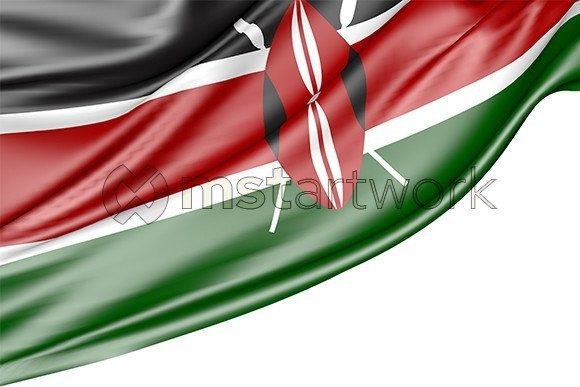
National flags carry deep meaning, and color inaccuracies can be perceived as disrespectful or unprofessional. The Kenyan flag features specific shades of black, red, green, and white, separated by white fimbriation. A common oversight occurs when designers rely on screen colors (RGB) for print projects (CMYK). Screens emit light, making colors appear vibrant and saturated, while ink absorbs light, often resulting in duller outputs. Without proper color profiling, the vivid red of the Kenyan flag may print as a muddy maroon, or the green may shift toward olive.
To avoid this, perform a test print before committing to a large batch of mugs, baby clothes, or wall art. Calibrate your monitor or request a physical proof from your print vendor. Additionally, be wary of generic stock illustrations that approximate national colors. Authentic representations adhere to official government color standards. When evaluating a Kenya Flag Isolated on White, zoom in to check the transition lines between colors. In 3D illustrations, lighting and shadows should enhance the flag’s form without distorting the proportions of the Maasai shield and spears. Distorted emblems or incorrect color ratios are immediate indicators of a low-quality asset that should be avoided for serious commercial or educational use.
Evaluating the "White Background" for Transparency Needs
The term "isolated on white" implies ease of use, but it does not automatically mean "transparent." Many beginners purchase or download a white-background JPG expecting to drag and drop it onto a colored website header or a dark t-shirt, only to find a stark white box surrounding the flag. This misunderstanding leads to wasted time attempting to remove backgrounds manually, often resulting in halos or chopped-off edges.
If your project requires true transparency, such as for stickers, scrapbooking overlays, or layered graphics, you must have a plan for conversion. While 3840×2160px provides ample data for clean extraction, using automated background removers on 3D rendered flags can be tricky because shadows and highlights may blend with the white background. Before starting, assess whether the shadow cast by the 3D flag is part of the aesthetic you want to keep. If so, manual masking in software like Photoshop or GIMP is superior to AI tools. If you need a floating object with no shadow, ensure the source image has high contrast between the flag and the white backdrop to facilitate a clean cut. Always retain the original high-res JPG as your master file so you can re-extract it if your initial attempt fails.
Strategic Application Across Different Media
Different end-products demand different treatments of the same source file. What works for a social media post may fail on fabric. Understanding these contextual requirements helps maximize the utility of your Kenya Flag Isolated on White Background.
- Social Media and Web: The 4K resolution allows you to crop specific sections of the flag for profile pictures or thumbnails without losing clarity. However, always optimize the final export for web speed. Serving a 5MB JPG on a website slows down load times and hurts SEO. Resize to the exact display dimensions needed.
- Print-on-Demand Apparel: For t-shirts and kids' clothes, the 3D aspect adds a premium feel compared to flat clip art. Ensure the DPI remains above 300 at the intended print size. If the flag covers a large chest area, verify that the fabric texture won’t obscure the fine details of the 3D rendering.
- Paper Products and Stationery: Greeting cards and posters benefit from the tactile suggestion of 3D illustrations. Here, color management is paramount. Matte paper absorbs more ink than glossy paper, so you may need to slightly increase saturation and contrast in your design software before printing to compensate for dot gain.
- Presentations and Education: Teachers and speakers often use flags against varied slide backgrounds. Because this asset is a JPG on white, use slide master templates with white content areas to maintain integrity. Alternatively, invest five minutes creating a high-quality transparent PNG version specifically for your slide deck to allow placement over photos or colored gradients.
Making Informed Decisions Before Downloading
Before integrating any national symbol into your work, conduct a brief audit of the asset's suitability. Check the metadata to confirm the resolution matches the stated 3840×2160px specification. Inspect the image at 100% zoom to look for compression artifacts, especially along the high-contrast edges of the black and white stripes. Verify that the 3D perspective aligns with your project’s visual style; a dramatic angle might look dynamic on a poster but could distort text placement on a business card.
Finally, consider the licensing and ethical usage. Just because a file is available does not mean it is appropriate for every context. National symbols should be treated with dignity. Avoid placing the flag in designs where it might be obscured, defaced, or associated with controversial messaging. By combining technical diligence with cultural awareness, you ensure that your use of the Kenya Flag Isolated on White is both visually stunning and respectfully executed. Taking these extra steps transforms a simple graphic asset into a powerful, professional communication tool.